


Author: Muhammad Shoaib, Content Writer and Blogger | Last updated: October 2026
Learning how to describe a beach in writing starts with one rule. Pick a mood, then choose a few exact details that support it. Strong writers do not list everything they see. They show the senses, action, and precise words.
This guide shows how to describe a beach in writing in six clear steps. You will also get a checklist of beach details, mood examples, word lists, and a before and after revision. It works for students, novelists, and travel bloggers. For the wider topic, read our complete beach writing guide.
Why Learning How to Describe a Beach in Writing Matters
A beach is a familiar place, so readers arrive with their own memories. Your job is to guide those memories, not replace them. Good description sets the mood, builds the setting, and shows how a character feels. That is why knowing how to describe a beach in writing is worth the practice.
Weak description fails in two ways. It stays too general, as in “the beach was nice.” Or it floods the reader with every wave, shell, and gull. Strong description sits in the middle. It uses a few exact details that carry feeling.
How to Describe a Beach in Writing: A Six Step Method
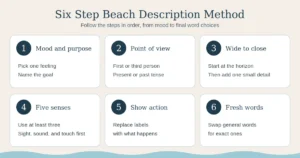
Follow these steps in order. This method shows how to describe a beach in writing for essays, stories, and blog posts.
Step 1: Decide the Mood and Purpose
Start with the feeling you want. Peaceful, lonely, joyful, and tense beaches need different details. A peaceful beach has soft light and slow waves. A tense beach has wind, gray water, and empty sand.
Then name the purpose. An essay needs clear structure. A story scene must serve the plot.
Step 2: Choose a Point of View and Tense
First person places the reader inside your senses. Third person lets you describe what a character notices. Present tense feels immediate. Past tense feels like memory. Pick one pair and keep it for the whole scene.
Step 3: How to Describe a Beach in Writing From Wide to Close
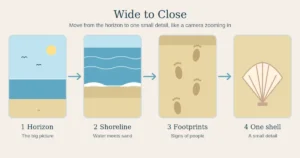
Open with the big picture, such as the horizon, the weather, and the length of the shore. Then move to smaller details, such as a shell, a footprint, or a dropped towel. This works like a camera. It keeps the reader oriented and avoids a jumble of details.
Step 4: How to Describe a Beach in Writing With the Five Senses
Sight is only the start. Ask one question for each sense, then write down your best answer.
| Sense | Question to ask | Sample detail |
|---|---|---|
| Sight | What color and shape are the water, sand, and sky? | Pale green water fading to gray at the horizon |
| Sound | What can you hear beyond the waves? | Gulls, flapping flags, a distant radio |
| Touch | How do the sand, water, and wind feel? | Gritty sand stuck to wet ankles |
| Smell | What does the air carry? | Salt, seaweed, coconut sunscreen |
| Taste | What reaches the mouth? | Salt on the lips from the spray |
Use at least three senses in every scene. This habit is the core of how to describe a beach in writing so that readers feel it.
Step 5: Show Action Instead of Labels
Labels like “crowded” or “peaceful” tell the reader what to think. Action lets them see it.
Telling: The beach was crowded.
Showing: Towels overlapped like puzzle pieces, and every few steps a ball bounced across the sand.
The second line proves the crowd without using the word.
Step 6: Revise for Fresh Words
Circle every general word, such as nice, beautiful, and big. Replace each one with a specific noun, verb, or image. Cut clichés like golden sand and crystal clear water unless you can give them a new twist.
What to Include in a Beach Description
A beach has more to offer than sand and water. This checklist helps you choose which parts to use.
| Element | Details to consider | Sample phrase |
|---|---|---|
| Sand | Color, texture, shells, pebbles | Sand dotted with broken shells |
| Water and tides | Wave size, color, tide pools | A low tide that exposed the tide pools |
| Sky and weather | Light, wind, clouds, fog | A thin fog that muffled every sound |
| Plants and animals | Dune grass, gulls, crabs, sandpipers | Sandpipers racing the retreating foam |
| People and activity | Swimmers, surfers, vendors, families | Surfers waiting for the next set |
| Human traces | Footprints, sandcastles, litter | Footprints already filling with water |
| Season | Summer crowds, winter quiet | The off season hush of a closed boardwalk |
You will never use every row. Pick the three or four that best support your mood.
How to Describe a Beach in Creative Writing
Fiction asks for more than a pretty picture. Knowing how to describe a beach in creative writing means weighing character, mood, and plot together. Beach description creative writing works best when the setting shows what a character feels.
Let the Character Color the Scene
A grieving character sees a different beach from a child on vacation. The grieving character may notice empty chairs and cold wind. The child notices the ice cream truck and warm sand. Describe what your character notices, and the reader learns about the character too.
Add Movement and Weather
Beaches move constantly. Waves break, kids run, and gulls dive. A storm or a fog bank can change the mood without changing the place. Movement keeps description alive and stops it from reading like a photograph.
Break Up Long Description
In fiction, split a big description into small pieces. Place each piece between lines of action or dialogue. This keeps the story moving.
For prompts and more ideas, see our guide to beach creative writing.
Use Figurative Language Carefully
Figurative language adds freshness when you use it with care. A simile compares two things using “like” or “as.” A metaphor says one thing is another. Personification gives human actions to nature.
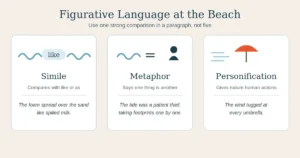
- Simile: The foam spread over the sand like spilled milk.
- Metaphor: The tide was a patient thief, taking footprints one by one.
- Personification: The wind tugged at every umbrella.
Use one strong comparison in a paragraph, not five. Pick images from the beach itself or from your character’s life. A comparison that fits the scene feels natural. A random one pulls the reader out of it.
How to Describe a Beach in Writing for School Tasks
The Purdue Online Writing Lab explains that a descriptive essay asks you to describe a place, an experience, or an emotion. Its goal is a vivid image in the reader’s mind. Purdue also suggests starting with a list of descriptive words for your subject.
Here is how to describe a beach in writing for class using that idea. Beach descriptive writing works best with one dominant impression, such as calm or loneliness. Support that impression with specific details. This plan works well:
- Opening: set the time, place, and mood in two or three sentences.
- Body: give each paragraph one focus, such as sight and sound, then touch and smell.
- Ending: close with a feeling or a lasting image.
Keep the same tense from start to finish. Vary your sentence length. Avoid turning each paragraph into a list. For full samples, read our beach descriptive writing examples.
How to Describe the Beach in Creative Writing by Mood
The same shoreline can feel peaceful, tense, or joyful. This table shows how details change with the mood.
| Mood | Key details | Sample line |
|---|---|---|
| Peaceful | Soft light, slow waves, warm sand | Slow waves folded onto the sand, one after another, and nobody hurried them. |
| Romantic | Sunset, shared warmth, low voices | The sky faded to rose, and their footprints filled with water behind them. |
| Tense | Fog, empty sand, odd noises | Fog swallowed the pier, and somewhere inside it a bell rang once. |
| Lonely | Winter wind, closed stalls, gray water | The boardwalk shops stood shuttered, and the wind pushed one plastic bag across the empty sand. |
| Joyful | Noise, bright colors, motion | Kites jerked overhead while three kids raced a wave and lost. |
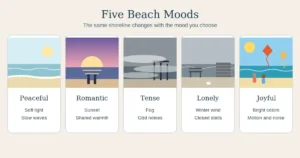
These examples show how to describe the beach in creative writing for almost any genre. Pick the row that matches your scene and borrow the method, not the words. Use the table as a quick reference for how to describe a beach in writing with a clear mood.
Words and Phrases to Describe a Beach
The right words are a big part of how to describe a beach in writing. Choose words that match your mood and avoid repeating the same ones.
| Word | Meaning | Sample sentence |
|---|---|---|
| Powdery | Fine and soft | The powdery sand slid through her fingers like flour. |
| Windswept | Shaped by strong wind | A windswept shore lay bare of umbrellas. |
| Glassy | Smooth and shiny | The glassy water mirrored the pink sky. |
| Churning | Moving with force | Churning surf pulled at the rocks. |
| Bustling | Busy and lively | The bustling boardwalk smelled of fried dough. |
| Desolate | Empty and bleak | A desolate beach stretched out under heavy clouds. |
| Briny | Salty | Briny air stung his lips. |
| Languid | Slow and relaxed | The languid afternoon passed without a plan. |
Weak words also slip in easily. This table shows quick swaps.
| Weak word | Stronger options |
|---|---|
| nice | restful, inviting, tranquil |
| big waves | towering breakers, rolling swells |
| walked | strolled, trudged, waded |
| loud | roaring, crashing, thundering |
| hot sand | scorching sand that stung bare feet |
Use only a few of these words in each scene. A paragraph packed with fancy vocabulary reads like a list.
How to Describe Different Types of Beaches
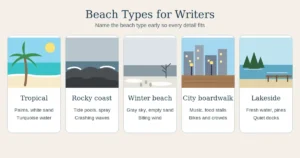
Not every beach feels the same. A rocky Maine shore and a Gulf Coast beach in Florida need different details. The type of beach also changes how to describe a beach in writing.
| Beach type | Details to use | Typical mood |
|---|---|---|
| Tropical | Palms, white sand, turquoise water, warm breeze | Relaxed |
| Rocky coast | Tide pools, crashing waves, cold spray, gulls | Wild |
| Winter beach | Gray sky, empty sand, biting wind | Lonely or calm |
| City boardwalk | Music, food stalls, bikes, crowds | Lively |
| Lakeside | Fresh water, small waves, pines, quiet docks | Calm |
Name the beach type early. Every detail that follows will then feel like it belongs.
Before and After: How to Describe a Beach in Writing Better
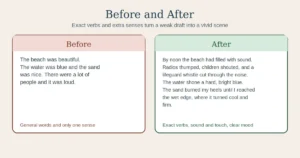
Revision is where good description happens. Start with a weak draft.
Before: The beach was beautiful. The water was blue and the sand was nice. There were a lot of people and it was loud.
This version uses general words and only one sense. Now compare a stronger rewrite.
After: By noon the beach had filled with sound. Radios thumped, children shouted, and a lifeguard whistle cut through the noise. The water shone a hard, bright blue. The sand burned my heels until I reached the wet edge, where it turned cool and firm.
Three changes made the difference:
- Exact verbs replaced general words.
- Sound and touch joined sight.
- The mood became clear without naming it.
Common Mistakes to Avoid
Most errors in how to describe a beach in writing come from a few habits.
- Using only sight and ignoring other senses
- Repeating clichés like golden sand and endless blue sea
- Listing details without a clear mood
Another common mistake is switching tense in the middle of a scene. Do not stack too many adjectives either. One exact noun usually beats three vague ones. Also avoid copying phrases from word lists. Borrowed lines sound generic. If a detail does not support the mood, cut it.
Summary
To recap how to describe a beach in writing, start with a mood and a purpose. Pick a point of view, move from wide to close, and use at least three senses. Show action instead of labels, and revise weak words into exact ones. Use the mood table, word lists, and beach types in this guide to match your scene. Practice the method on one short paragraph, and you will see the difference quickly.
Three Common Questions
How Do You Describe a Beach in Creative Writing?
Pick a mood first. Then describe the beach through a character’s eyes. Use at least three senses, and add movement such as waves, people, or birds. Show feelings through details instead of labels like “beautiful.”
What Are Good Words to Describe a Beach?
Good words are exact and tied to what you see, hear, and feel. Examples include powdery, windswept, turquoise, hissing surf, and long shadows. Match them to your mood and avoid worn phrases like crystal clear water.
What Is the Easiest Way to Learn How to Describe a Beach in Writing?
To learn how to describe a beach in writing, practice the six step method on one small scene. Write for ten minutes about one mood and three senses. Then replace each general word with a specific one. Repeat with a new mood.
About the Author
Muhammad Shoaib is a content writer and blogger with 5 years of experience in SEO content. He runs Broadpedia, where he publishes informational articles. He completed 14 years of education with computers as his field of study.
