





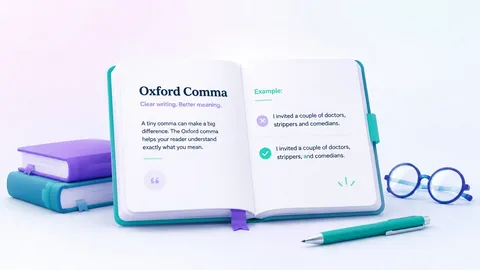
The oxford comma is one of the most discussed punctuation marks in the English language. It has ended friendships, started internet arguments, inspired a hit song, and even decided a five million dollar lawsuit. This guide covers everything a reader needs to know about it, including its definition, its grammar rules, its history, the style guides that support or reject it, and the real world cases where it mattered.
This article focuses only on informational intent. Every section answers a real question people search for when they want to understand this small but widely debated mark, not buy something or navigate to a specific brand or tool.
What Is an Oxford Comma
It is the final comma placed before the word and or or in a list of three or more items. It is also known as the serial comma or the Harvard comma.
Example without it: I bought apples, bananas and oranges.
Example with it: I bought apples, bananas, and oranges.
Both versions are grammatically acceptable. The choice depends on which style guide a writer follows and whether the sentence needs extra clarity.
A Simple Definition in Plain English
People often type slightly different versions of the same question into search engines, including what is a serial comma, what are these commas called, what’s the correct name for it, and how it is defined. All of these questions have the same answer. It is a comma placed right before the last item in a list, directly ahead of and or or.
What It Looks Like in a Sentence
It looks exactly like a normal comma. Its identity comes from its position in a sentence, not its shape. It always sits directly before the final conjunction in a series of three or more items.
Consider this often cited example:
Without it: She invited her parents, Lady Gaga and Humpty Dumpty.
With it: She invited her parents, Lady Gaga, and Humpty Dumpty.
The version with the comma makes it instantly clear that Lady Gaga and Humpty Dumpty are separate guests, not her parents. This single example explains why so many editors default to using it every time.
Where the Name Came From
The term comes from Oxford University Press. Editors at the press have long recommended the serial comma in its house style guide, which led to the punctuation mark being named after the university rather than after a grammar rule itself. Over time, the name spread beyond publishing circles and became common across American and British English, even outside academic writing.


How to Use the Oxford Comma
Using it correctly comes down to one consistent pattern. Add a comma before the final conjunction whenever a sentence lists three or more items.
When This Rule Applies
It becomes especially important in these situations.
- When a list includes names of people, since missing commas can wrongly group two people together
- When items in a list could be misread as describing each other
- When a sentence would otherwise create an unintended or confusing meaning
Using It Consistently in Everyday Writing
Writers who choose to use it should apply it consistently across every list, not only in sentences that seem confusing without it. Consistency is what most professional style guides recommend, since switching back and forth mid document creates its own confusion for readers.
Style guides that recommend consistent use of the serial comma include the Chicago Manual of Style, the Oxford Style Manual, and most academic publishing standards used in universities across the United States.
Is the Oxford Comma Grammatically Correct
Yes. It is grammatically correct. Leaving it out is also grammatically correct. Neither choice is a punctuation mistake on its own. What changes is clarity, tone, and which style guide a publication follows.
Is It Always Necessary
It is not always necessary, but it frequently prevents confusion. Many sentences read perfectly fine without it. Others create an unintended and sometimes funny meaning.
A widely shared example involves a fictional book dedication that reads:
To my parents, Ayn Rand and God.
Without a comma after Rand, the sentence appears to claim that Ayn Rand and God are the writer’s parents. Adding the missing comma removes the confusion completely:
To my parents, Ayn Rand, and God.
Why It Matters
It matters because English sentences depend heavily on commas to group and separate ideas. A single missing comma can change legal meaning, financial meaning, or simple clarity. This is not just a theoretical concern. It has played out in real courtrooms, which the next section covers in detail.
The Oxford Comma Lawsuit That Cost Five Million Dollars
One of the clearest real world examples of why this rule matters came from a 2017 court case in Maine. A group of delivery drivers sued Oakhurst Dairy, arguing they were wrongly denied overtime pay.
Maine’s overtime law listed job duties that were exempt from overtime pay, including the canning, processing, preserving, freezing, drying, marketing, storing, packing for shipment or distribution of perishable foods. Because there was no comma after packing for shipment, it was unclear whether distribution was its own separate exempt activity or simply part of packing for shipment.
The drivers distributed products but did not pack them. If distribution counted as its own separate exempt task, they would lose the case. If it did not, they were entitled to overtime pay.
In March 2017, the United States Court of Appeals for the First Circuit ruled in favor of the drivers, stating that the missing comma created enough ambiguity to interpret the law in their favor. Judge David Barron wrote in the ruling, for want of a comma, we have this case. In 2018, Oakhurst Dairy agreed to a five million dollar settlement with its drivers, as later confirmed by CNN.


This case is one of the most cited real world examples of the oxford comma’s practical importance, and it is frequently referenced by lawyers, journalists, and grammar educators as proof that punctuation carries legal weight. Coverage from outlets including NPR and the New York Times helped turn a fairly technical labor dispute into a widely shared story about grammar’s real world stakes.
The case also drew attention within the legal profession itself. The ABA Journal reported on the eventual settlement, noting that the dispute became a touchstone example cited in law school classes and legal writing guides about the importance of precise drafting. Some legal commentators have since pointed out that the case was less about this one comma specifically and more about ambiguous drafting in general, since a semicolon or a restructured sentence could have resolved the confusion just as effectively. Either way, the case remains the most commonly cited real world instance of punctuation directly affecting a financial and legal outcome.
AP Style and the Oxford Comma
Not every style guide agrees on this rule. This disagreement is one of the most common sources of confusion for American writers.
Does AP Style Require It
The Associated Press Stylebook, used by most American newspapers and news organizations, does not require it in a simple list. AP style only adds it when leaving it out would create genuine confusion.

Example following AP style without it: The flag is red, white and blue.
Example where AP style adds the comma for clarity: He thanked his coaches, Beyoncé, and Jay Z.
Style Guide Comparison Table
| Style Guide | Requires Oxford Comma | Typical Use Case |
| AP Stylebook | No, only when needed for clarity | Newspapers, news websites, press releases |
| Chicago Manual of Style | Yes, always | Books, academic writing, publishing |
| Oxford Style Manual | Yes, always | British academic and formal writing |
| MLA Style | Yes, generally recommended | Academic essays and research papers |
| APA Style | Yes, always | Psychology, science, and social science writing |
This table explains why the same sentence can look different depending on where it is published. A news article may drop the comma, while a novel, academic paper, or scientific journal will almost always keep it.
Oxford Comma in Pop Culture
This punctuation mark is not just a grammar rule. It has become a genuine part of internet and music culture, referenced in songs, jokes, and viral posts.
The Vampire Weekend Song
One of the most well known pop culture references is the song Oxford Comma by the band Vampire Weekend. Released as a single on May 26, 2008 from their self titled debut album, the song opens by questioning whether anyone truly cares about this rule. Written by lead singer Ezra Koenig, the track became one of the band’s most recognized songs and introduced the term to many listeners who had never studied the rule before. The song’s music video was directed by comedian Richard Ayoade and premiered in June 2008.


Fans searching for the song are usually looking for information about its meaning or lyrics rather than the grammar rule itself, which is why this topic deserves its own space within a complete guide to the term.
Memes and Funny Examples
The internet has produced countless memes and jokes about this comma over the years. Most follow the same structure. They present a sentence without the comma that accidentally implies something absurd.
A commonly shared joke describes someone thanking their parents, a historical dictator, and an exotic dancer, without a comma before the final name. Without it, the sentence appears to claim the first two people are actually those two figures. Adding the comma instantly fixes the unintended meaning.
This style of humor works because English grammar genuinely allows ambiguity in lists. The joke is not really about grammar rules. It is about how a single missing comma can create a completely different, often absurd, meaning.
Why the Oxford Comma Still Matters Today
Language changes constantly, but this small mark remains one of the clearest examples of how a single punctuation choice affects meaning. Whether a writer follows AP style, Chicago style, or personal preference, understanding this rule leads to clearer, more professional writing.
Editors, students, marketers, lawyers, and everyday writers all benefit from knowing when and why to use it. As the Oakhurst Dairy case shows, it takes seconds to apply but can prevent real financial and legal consequences in contracts, laws, resumes, and everyday communication. Even in casual writing, where the legal stakes are lower, the same habit of double checking a list for potential ambiguity tends to produce clearer, more professional sentences overall.
Sources and Further Reading
This guide draws on information from Oxford University Press style guidance, the AP Stylebook, the Chicago Manual of Style, and reporting from the New York Times, NPR, CNN, and the ABA Journal on the Oakhurst Dairy case.
Frequently Asked Questions
What is an oxford comma
Is the oxford comma correct
Does AP style use the oxford comma
When should I use an oxford comma
Is the oxford comma required in American English
Why is the Vampire Weekend song called Oxford Comma
What was the oxford comma lawsuit about
Is the oxford comma the same as the serial comma

